By February on a narrow lot the banks are as high as the blade, the street is prohibited, the neighbor’s property is prohibited, and there is nowhere left to put anything. At that point the snow has to leave, and that is a different service with a different price.
The lot has run out. A long narrow driveway with a fence on one side and a lot line on the other has a finite amount of storage beside it, and a heavy season uses it up. Lakewood is the sharpest case in the metro — the densest municipality here at 9,191 people per square mile, banning snow pushed into the street and onto a neighbor’s property.
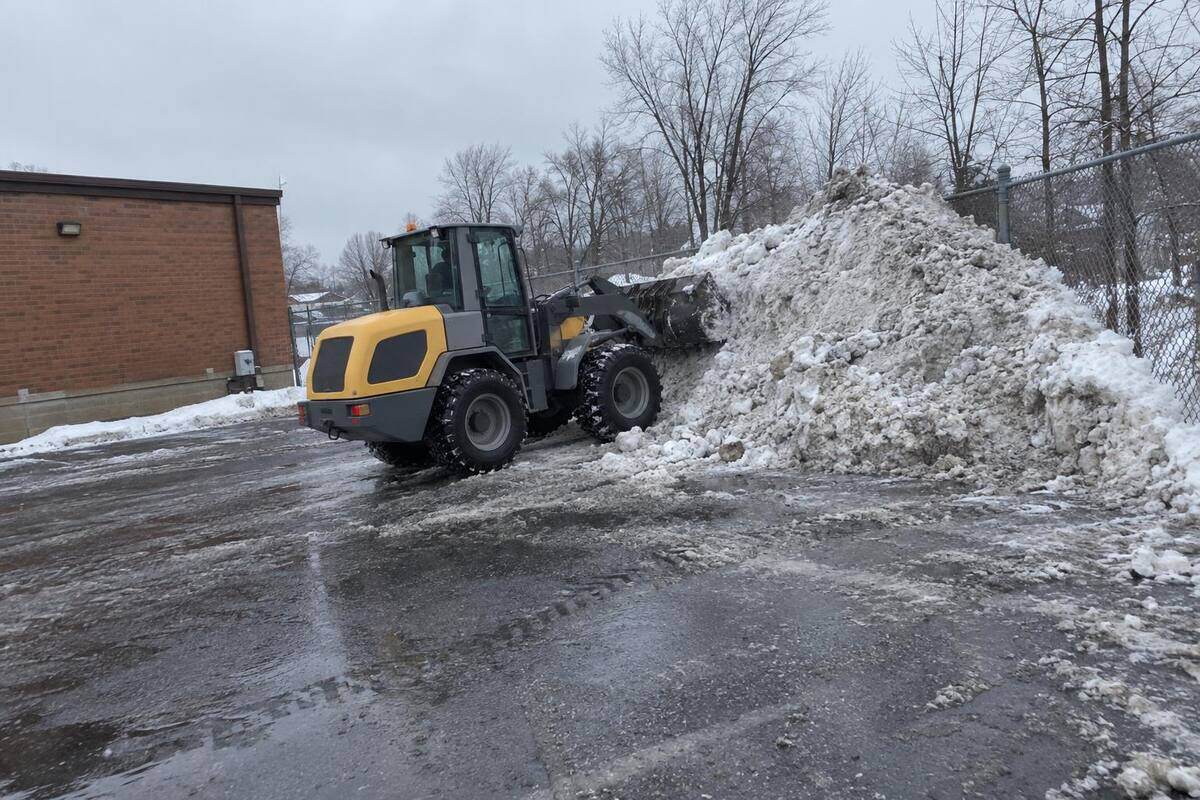
The pile is in the way. On a commercial lot the stack eventually occupies parking, blocks sightlines at an entrance, or sits where meltwater will run back across the traffic lane and refreeze.
It is going to melt somewhere. A pile stacked against a foundation wall or over a basement window well is a water problem waiting for the first warm day, and in a metro where every house has a full basement that is not a theoretical concern.
There is a ladder here and the cheapest rung is usually enough. Restacking moves the existing banks back and up with a loader or a blower to recover room for the rest of the season. Relocating moves it to an unused corner of the same property — the back of a lot, a verge, an area that is not needed until spring. Hauling loads it and takes it away, and is the expensive option because it is trucks and time.
Where it goes when it leaves matters and is worth asking about. Snow off a plowed surface carries road salt, grit and whatever else was on the pavement with it, which is why a contractor should have a deliberate answer rather than an improvised one.
The decision that prevents most of this is made before the season: where does the snow go, and in what order do the piles get built? A contractor who starts the season stacking in the most convenient spot rather than the most useful one runs out of room in January.
On a residential property that means naming the storage area on the contract. On a commercial site it means agreeing the pile locations against the parking layout, the drainage and the sightlines before the first push. Commercial lots →
Say how much space is left, where the banks are and whether anything has to stay usable. Restacking is often enough and costs a fraction of hauling.
Call (216) 677-6862 Get a Season Price Cleveland