Most snow removal sites sell roof clearing by implying your roof is about to fail. This one will not, because no Ohio-specific roof snow load data and no Northeast Ohio collapse statistic could be found — so there is no honest number to quote in either direction. The real reason to deal with roof snow here is simpler and better documented: ice dams, and the water they push back under the shingles.
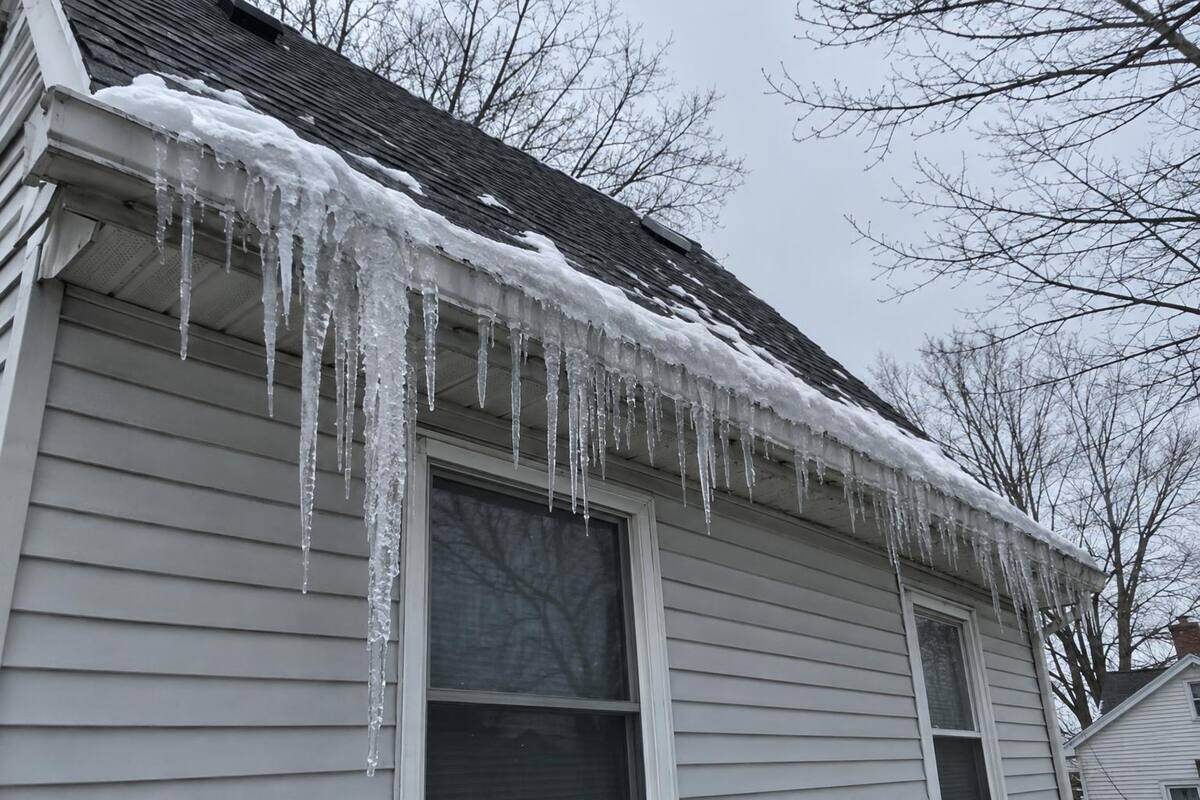
The housing stock here is steeply pitched asphalt shingle, and ice dams are a common and genuine failure mode on it. The mechanism is not dramatic: heat escaping through the roof deck melts snow high up, the meltwater runs down to the cold overhang past the heated part of the house, and it refreezes there into a ridge. The next round of meltwater backs up behind that ridge and sits on the roof — and shingles are built to shed running water, not to hold standing water.
Then it goes where standing water goes: under the shingle course, through the deck, down inside a wall. In this metro that trip usually ends in a basement, because full basements are universal in Northeast Ohio. The damage is rarely the roof itself. It is the ceiling, the wall cavity, the insulation and whatever is stacked downstairs.
Do not go up there. Do not climb onto a roof to shovel snow off it, and do not chip, hammer or pry at an ice dam. Both are how a water problem becomes an injury and a shingle-replacement bill at the same time.
The method Northeast Ohio contractors actually use is low-pressure steam — equipment that melts a channel through the dam without striking the roof. One regional operator running a Cleveland-specific service says it steams only; a Northeast Ohio roofer running the same service describes an arctic steamer at 290°F. Several other companies across this metro sell the same work.
What to avoid, and why: rock salt or ice melt thrown onto shingles corrodes flashing and fasteners and does very little to a dam of that size; a pressure washer drives water under the course you are trying to protect; and mechanical chipping takes granules off asphalt shingles, which is the layer doing the waterproofing.
Roof snow clearing, done from the ground with a roof rake on the lower few feet of the roof, is the preventive half of this and is the part a homeowner can reasonably arrange before a dam forms. Once a dam exists and water is inside, it is a steam job.
This is a real gap and it is worth being direct about it: no Cleveland-metro contractor publishes an ice dam or roof snow removal price. Several sell the service across Northeast Ohio and none of them puts a figure on the page.
The only Ohio-published figures found come from a roofer in Fresno, Ohio — Central Ohio, not this metro, and they are reproduced here with that label attached rather than presented as Cleveland prices:
| Item | Published range |
|---|---|
| Professional steam removal, typical | $500 – $1,500 |
| Emergency hourly rate | $500 – $900/hr |
| Severe cases | $2,000+ |
| Resulting water damage, minor | $550 – $2,000 |
| Resulting water damage, restoration | $2,000 – $10,000+ |
Treat those as an order of magnitude from elsewhere in the state, not as a quote. The useful thing they do show is the ratio: the removal is the cheap part.
An ice dam forms because the roof deck is warm where it should be cold. The long-run fixes are insulation and air sealing at the ceiling plane, and ventilation that keeps the deck near outside temperature — not a bigger gutter and not a heat cable, which manages a symptom at a running cost.
The seasonal fixes are smaller and worth doing: keep gutters and downspouts clear before the first freeze so meltwater has somewhere to go, and rake the lower few feet of roof from the ground after a heavy snow rather than letting a load sit through a freeze-thaw cycle.
One local detail that belongs on this page: where the meltwater ends up is a foundation question here. Downspout discharge that refreezes against a foundation wall, and a plow ridge packed over a basement window well, are both ordinary Northeast Ohio complaints and both are made worse by the same week of weather.
A pre-1960 Cleveland or inner-ring house tends to arrive with all of this at once: a steeply pitched shingle roof that forms dams, a full basement for the water to find, a long narrow driveway to a garage at the back of the lot, and a public sidewalk frontage governed by an ordinance that in Cleveland wants it clear before 9 a.m. daily.
That is one property profile and four separate pieces of winter work, and it is worth quoting as a whole rather than one emergency at a time.
Call rather than using the form, and do not go onto the roof. Steam removal is the work; chipping at the ice makes it a roof replacement.
Call (216) 677-6862 Get a Season Price Cleveland