In much of this metro the garage is at the back of the lot, reached by a long narrow driveway running the full length of the property. That driveway is the job here. It is not a bigger version of a suburban apron, and a quote written as though it were will be wrong in both directions.
A high share of the housing in Cleveland and the inner ring predates 1960 — colonials and bungalows built when a car went behind the house rather than beside it. The result is a driveway that is long, narrow, and bounded on both sides by a fence, a hedge or a neighbor’s lot line.
Three things follow from that, and all three show up on a price:
Where the snow can legally go is not a detail here. Lakewood bans pushing it into the street and onto a neighbor’s property; Solon extends its street ban explicitly to contractors; Mentor says pushing it into the roadway violates city ordinance. On a tight lot those three rules together can leave very few options. What your city says →
This is worth saying clearly, because a site that described every Cleveland driveway the same way would be as wrong as one that described none of them correctly.
Solon and Strongsville are newer colonials with attached garages — Solon went from 11,519 residents in 1970 to 24,262 in 2020, Strongsville from 15,182 in 1970 to 28,577 by 1980. Twinsburg built out almost entirely in the 1990s. Avon is up 118.8% since 2000 and is overwhelmingly 2000s stock. In all of those the apron is the whole job, and it prices lower for a good reason.
Cleveland, Lakewood, Cleveland Heights, Shaker Heights and the rest of the pre-war ring. Shaker Heights was laid out from 1905 around deep lots and built out 1915 to 1940. Lakewood went from 3,355 residents in 1900 to 70,509 by 1930 and is now the densest municipality in the metro at 9,191 people per square mile. The driveways match the era.
Westlake, Mentor, Elyria, Euclid and Berea carry both patterns inside one city. The city name tells an operator nothing useful in these places, which is exactly why the quote question is “attached or at the back?” rather than “where do you live?”
Chardon, Chesterland, Bainbridge, Moreland Hills, Concord Township, Hudson. Long private drives, frequently sloped, often tree-lined, sometimes with a turnaround. Different again — length and grade rather than width and lot lines — and in the snow belt, cleared far more often.
A driveway price in this metro is the driveway multiplied by the zone. The published local figures are $550 to $1,250 for the season or $50 and up per push from the one Cleveland contractor who puts prices on the page, and $40 to $100 per visit by size from a cost page compiled with contractor feedback — $40 to $50 for a 12×30 single-car drive, $80 to $100 for a 24×60 two-car.
Then the zone moves it. A snow-belt address is cleared two or three times as often across a season as a west-side one, on identical terms. That frequency, not the square footage, is the biggest single number behind your quote — and it is the part nobody in this market explains. Find your zone → · Full pricing →
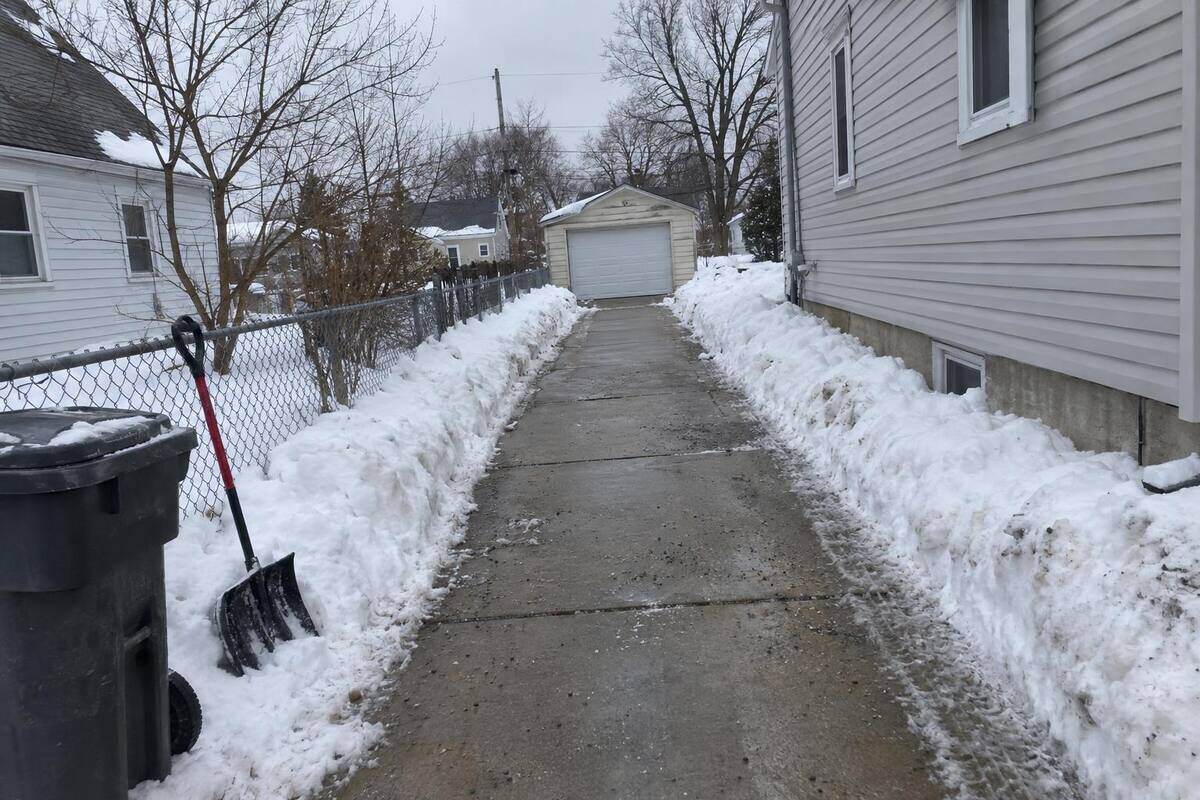
Length, width, whether the garage is attached or at the back, and where the snow can go. Four answers and the range becomes a number.
Call (216) 677-6862 Get a Season Price Cleveland